
1. Problem description:
Hello, ProblemHunt community.
It all started with a conversation with the owner of a small online furniture store. He shared a background concern: his website might have legal risks that could lead to fines and other problems. During our discussion, it became clear that existing solutions — Termly, iubenda, CookieYes, and others — are mainly focused on Privacy, Cookies, and basic legal documentation, covering at most ~20–30% of what this website owner is actually worried about.
This became the starting point for the research we worked on over the last month. During that time, we found and personally spoke with 28 small business owners from different niches and countries — and all of them face the same problem. The conclusion was clear: no solution on the market fully addresses their real concerns.
At the same time, there are about 358 million small business owners worldwide, 73% of whom have their own website, and the entire Legal AI market is already valued at $3.11 billion and continues to grow.
We have packaged all the details and insights from the research into one comprehensive document that will provide clarity and speed ahead of potential competitors. Inside:
Bonus: All 28 respondents trust us and are ready to use the future solution. For the first three developers who build a working MVP, we will personally present it to the respondents, collect their feedback, and send everything in one file with the respondents’ direct contacts.
Price: $99. Buy directly in our Telegram community. Or get it for free.
We are confident this is a real problem and that people are willing to pay to solve it, so you have exactly one year to verify that. If it turns out otherwise — we’ll give you free access to any validated problem.
It all started with a conversation with the owner of a small online furniture store. He shared a background concern: his website might have legal risks that could lead to fines and other problems. During our discussion, it became clear that existing solutions — Termly, iubenda, CookieYes, and others — are mainly focused on Privacy, Cookies, and basic legal documentation, covering at most ~20–30% of what this website owner is actually worried about.
This became the starting point for the research we worked on over the last month. During that time, we found and personally spoke with 28 small business owners from different niches and countries — and all of them face the same problem. The conclusion was clear: no solution on the market fully addresses their real concerns.
At the same time, there are about 358 million small business owners worldwide, 73% of whom have their own website, and the entire Legal AI market is already valued at $3.11 billion and continues to grow.
We have packaged all the details and insights from the research into one comprehensive document that will provide clarity and speed ahead of potential competitors. Inside:
- A clear profile of the target audience: who feels the pain most acutely and who is ready to pay.
- The exact product they want — taking all their preferences into account.
- The monetization model they prefer.
- Competitors and why this niche remains open.
- A step-by-step plan for promotion and sales without spending on paid marketing or SEO — this was one of the unexpected insights from the research.
- The landing page structure and messaging that will deliver the highest conversion rates.
Bonus: All 28 respondents trust us and are ready to use the future solution. For the first three developers who build a working MVP, we will personally present it to the respondents, collect their feedback, and send everything in one file with the respondents’ direct contacts.
Price: $99. Buy directly in our Telegram community. Or get it for free.
We are confident this is a real problem and that people are willing to pay to solve it, so you have exactly one year to verify that. If it turns out otherwise — we’ll give you free access to any validated problem.
2. The ProblemHunt Team:

Boris Gostroverhov, co-founder. 15 years in internet marketing across various businesses. Over 300 freelance projects, with more than 95% of clients satisfied with the partnership. Built three profitable online stores from scratch, two of which were sold as ready-made businesses. Over the past 10 years, he has done 18 startup launches — 90% failed for one core reason: they were not solving real people’s problems. That is exactly what pushed him to create ProblemHunt.

Victoria Gostroverhova, co-founder. Holds a degree in journalism and has experience working in regional media. She knows how to conduct interviews to extract what truly matters from a person. Her high level of empathy, confirmed by tests, helps her understand people and their real problems more deeply. She also has a background in psychology. Together with Boris, she has launched two startups and has a solid grasp of startup logic and objectives.
3. Why are we doing this?
Most startups fail, and the main reason is: they build something nobody needs. We ourselves were part of that majority and stayed there for a long time — until we understood the truth articulated by Paul Graham, founder of Y Combinator: you need to search not for startup ideas, but for problems. That is exactly what we do at ProblemHunt.
Our mission: 0% failed startups. We believe that together with the ProblemHunt community, we can achieve this.
Our mission: 0% failed startups. We believe that together with the ProblemHunt community, we can achieve this.
4. Why we don’t use AI for validation?
Our experience has shown that AI does not provide the depth we need. AI-driven research is mostly superficial and often leads in the wrong direction. Only live conversations with real people can confirm that a problem is truly worth solving. It is in these conversations that insights emerge — ones AI simply cannot see. And most importantly: for a respondent to open up genuinely, they need a living person who can listen and gently guide the conversation in the right direction — not a questionnaire or a scripted bot.
5. How we validate problems?
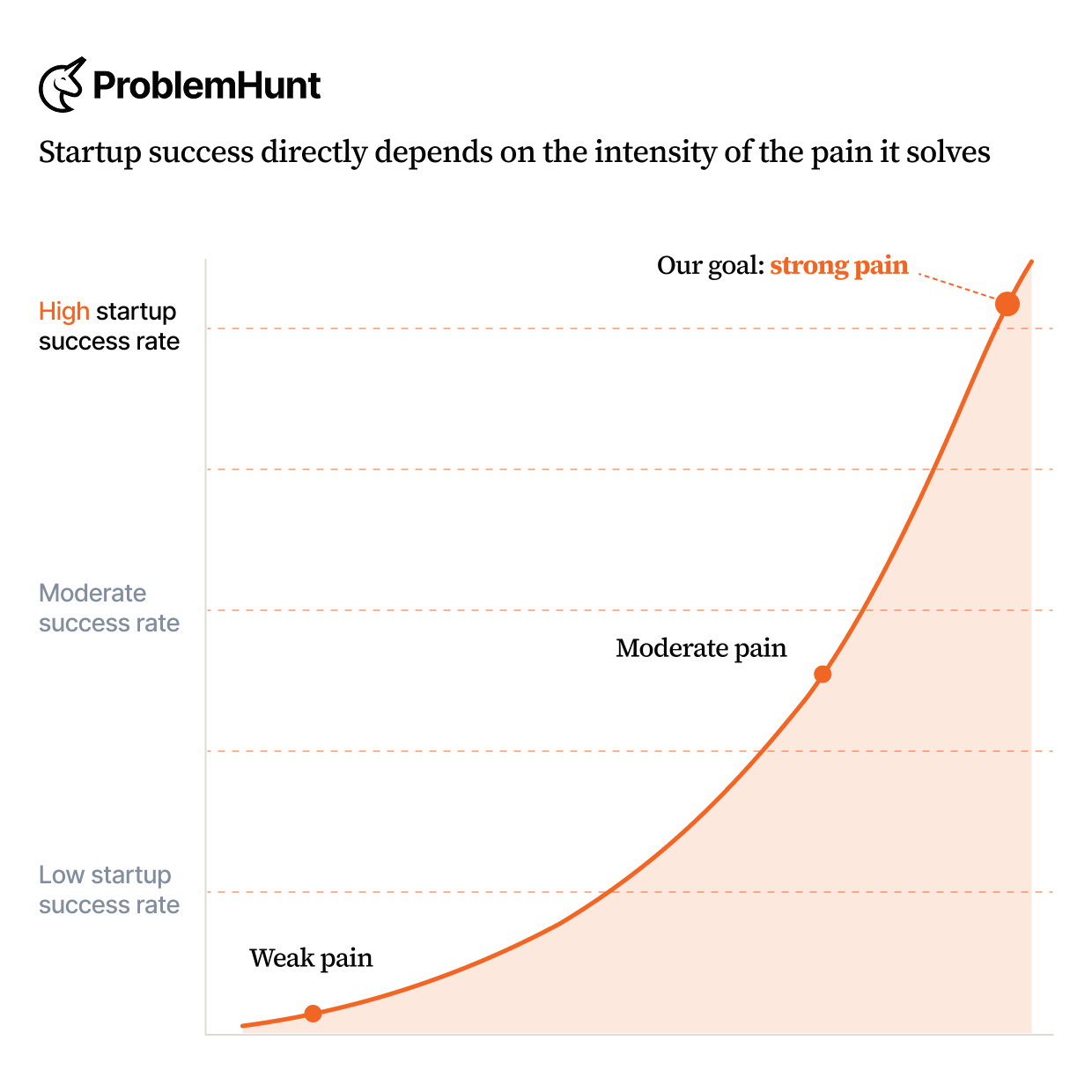
1. First and foremost, we measure the intensity of pain for each respondent. Why does this matter? The key insight we got while working on ProblemHunt: a startup's success directly depends on the intensity of the pain it solves. Everything else is secondary. This is exactly what Paul Graham (YC founder) meant when he wrote about the importance of solving acute problems, not shallow ones.
2. We rely on proven methods: Steve Blank’s Customer Development approach, Rob Fitzpatrick’s method from The Mom Test, and the recommendations of Paul Graham and Y Combinator.
3. For each problem, we create a unique and flexible interview script, the foundation of which we have tested on over 100 real people. Its key feature is that we almost never ask about the future, because people are often wrong about their predictions. All questions focus on what a person has actually done or is doing right now to cope with the problem. Behavioral details tell us far more than any intentions ever could.